One shared edit, one separate risk
This experiment has three fictional Fieldnotes pages: home, pricing and help. Each navigation changes the link text from “About” to “Our story.” The link destination stays #about. Only pricing also changes its robots meta directive.
Scroll horizontally to see all columns.
| Page | Shared visible edit | Robots before | Robots after | Worked decision |
|---|---|---|---|---|
| Home | About → Our story | index, follow | index, follow | Review the shared label |
| Pricing | About → Our story | index, follow | noindex, follow | Review label and indexing separately |
| Help | About → Our story | index, follow | index, follow | Review the shared label |
Three changed pages are not proof of three unrelated incidents. Equally, one grouped event is not proof that the pages have equal impact. The grouping is a way to organize attention. It must not remove the page-level evidence.
Inspect the shared edit
The pricing page before the edit shows the original “About” link.
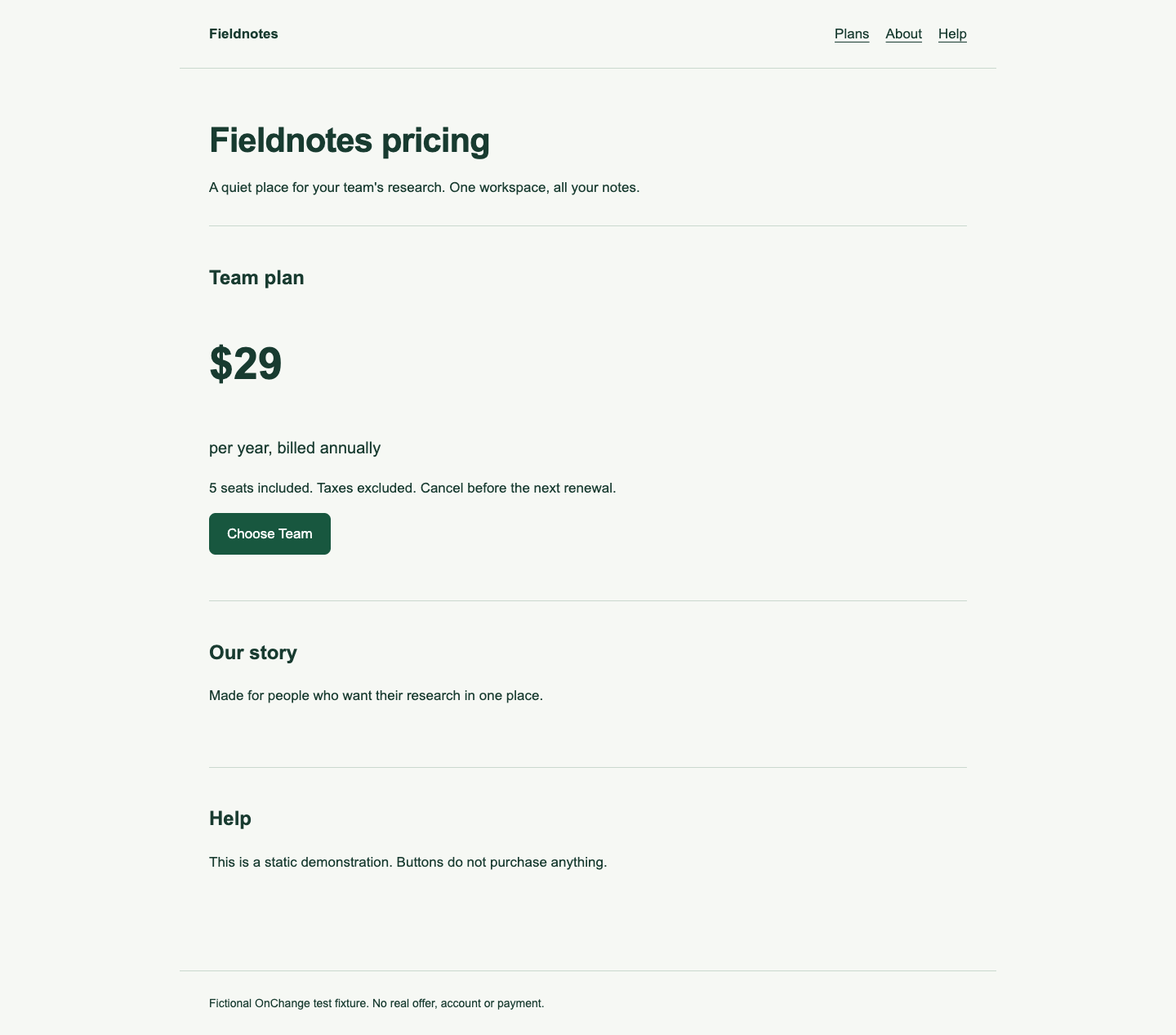
After the edit, “Our story” appears in its place. The new indexing directive lives in metadata and cannot be read from the screenshot.
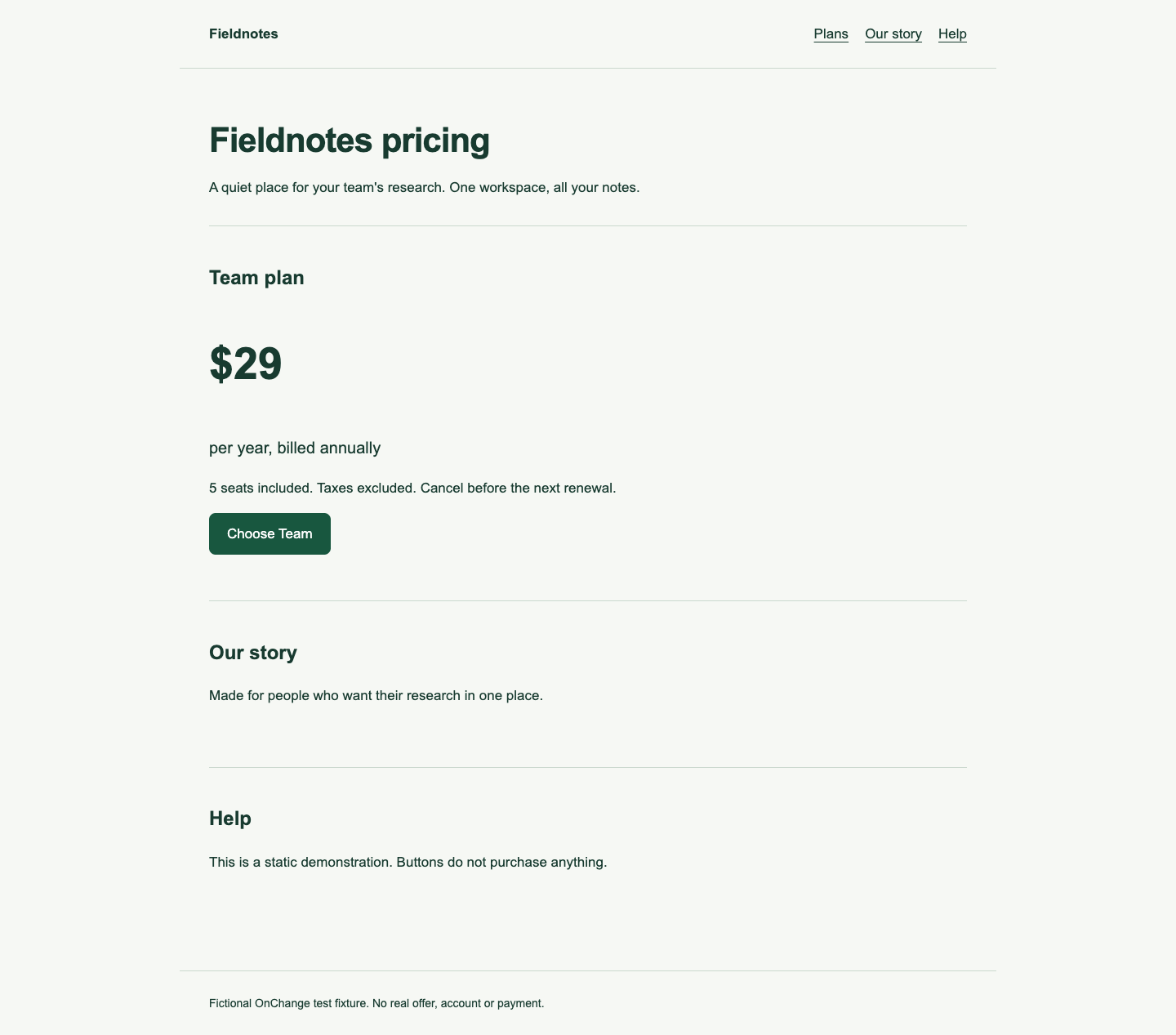
Inspect the fixture pairs: home before / home after, pricing before / pricing after, and help before / help after. Download the complete evidence record to read extracted metadata and the corresponding mobile captures.
How to review a group without hiding risk
- Confirm that the shared edit is actually the same. Read both labels and destinations; similar-looking screenshots do not establish common cause.
- Inspect the list of member pages. Check each page's severity, metadata and independent changes before taking a group action.
- Record the shared decision. For example: “The renamed navigation link matches the approved content change; keyboard and purpose checks are still due.” This is an illustrative note, not an actual customer's approval.
- Keep pricing open for a separate indexing decision. On a public pricing page intended for search, an unexpected
noindexneeds correction. On a private preview, it may be deliberate. - Split a change out if it does not belong. A convenient grouping should be reversible without discarding the original event.
OnChange's related-change workflow groups a matching shared text edit within a 15-minute window and retains the individual records and risks. A matching edit suggests a useful review group; it does not prove that the same code commit caused every change. This experiment illustrates the review principle. Its evidence was generated by the editorial harness, not by a production incident or a customer monitor.
What needs accessibility retesting?
The changed link name is new evidence. Review whether “Our story” still describes the destination and whether it remains meaningful in context. Check the keyboard journey through the navigation and any responsive implementation. The page's indexing risk is a different question from the link's accessibility.
Use the shared-navigation retest decision to distinguish affected evidence from uncertain evidence and checks that have not yet been performed. An automated scan with no findings does not answer whether the new wording makes sense.
Method and limits
The harness captured all six fixture files on 13 October 2026 at 17:14 UTC, using Chrome 155.0.8059.40 on macOS at desktop 1440 × 900 and mobile 390 × 844, scale 1. The rendered navigation text changed on all three pages. The stored robots field changed only on pricing. There is no inference about real alerts, real search results or release attribution.
Each file is static, uses the same embedded CSS and has no authentication, analytics or third-party resources. Our publishing server sends an additional X-Robots-Tag: noindex, nofollow for every fixture so fictional demo pages do not become search landing pages. The table compares the deliberately authored HTML meta directive, not the fixture's effective indexing policy on this host.
Get the fixture ZIP, reproduction notes and self-contained reproduction kit and source harness.